
Both the government and RBI are expecting the CAD to be below $56 billion in the current fiscal compared to the record high of $88.2 billion, or 4.8 per cent of the GDP last fiscal.

India's current account surplus moderated to $15.5 billion or 2.4 per cent of the GDP in the July-September quarter of the current fiscal, the RBI said on Wednesday. The same was at $19.2 billion or 3.8 per cent of the GDP in the preceding three-month period on account of a rise in the merchandise trade deficit, the RBI said in a statement on 'Developments in India's Balance of Payments during the Second Quarter (July-September) of 2020-21'. It is for the third consecutive quarter that India's current account remained in surplus. In the last quarter of 2019-20, the surplus was $0.6 billion. Current account deficit/surplus reflects the difference between the outflow and inflow of foreign exchange in a country's current account.

'Investors looking at the next 6-12 months can be certain that the Fed will maintain its easing cycle, and we expect the overall environment to be conducive for fixed income investments for portfolio diversification.'
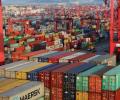
Though the government has been pushing for exports of high-value manufactured goods across major markets in place of raw materials and input goods, India's top exports to China remain in the raw materials category.

'In the new coalition government, India's reform agenda may prioritise job creation and factor market reforms.'

'... as has been happening in the last three weeks, then the foreign exchange reserves will not be comfortable to ensure that the rupee does not fall drastically.'

Indian growth in the rest of this fiscal year and next will be propelled by robust domestic consumption as consumer confidence improves, and by investment, including large increases in government capital expenditure, according to the Asian Development Outlook September 2023. "As slowing exports could foment headwinds for the economy, and erratic rainfall patterns are likely to undermine agricultural output, the growth forecast for FY2023 is revised down marginally to 6.3 per cent," ADB said.

'India has the potential to reduce its trade deficit with China by $8.4 billion in FY21.'

The rupee came under pressure on demand from importers as the dollar strengthened overseas.

Forex dealers said besides strong demand for the American currency from importers, capital outflows mainly weighed on the domestic currency.

China has emerged as India's largest trade partner.

Imports also declined by 13.46 per cent to $35.37 billion, leaving a trade deficit of $10.30 billion, according to the Director General of Foreign Trade A Pujari.

Equity benchmarks snapped their six-session rally to close marginally lower on Thursday amid profit booking in banking and energy counters. Investors also stayed on the sidelines ahead of the RBI's policy meet outcome on Friday. In choppy trade, the 30-share BSE Sensex ended 51.73 points or 0.09 per cent lower at 58,298.80. During the day, it hit a low of 57,577.05 and a high of 58,712.66.

The Survey is authored by Chief Economic Advisor V Anantha Nageswaran and his team.
The Reserve Bank on Tuesday said the government should deregulate diesel prices in order to contain the trade deficit, which is expected to widen to $160 billion during the current fiscal.

'The boycott has not achieved success. Sales figures for Chinese products on the top three Indian online retailers in the first week of October hit a new record. Amazingly, the Chinese mobile phone company Xiaomi sold half a million phones in just three days on the Flipkart, Amazon India, Snapdeal and Tata CLiQ platforms.'

India will not tailor its policies to suit US EV maker Tesla, and its laws and tariff rules will be formulated to attract all-electric vehicle manufacturers from across the world to set up a base in the world's fastest-growing economy, Commerce and Industry Minister Piyush Goyal said. Tesla has been seeking an initial tariff concession that would allow it to offset 70 per cent customs duty for cars priced less than $40,000, and 100 per cent for cars of higher value.

The government on Friday approved an electric-vehicle policy, under which duty concessions will be given to companies setting up manufacturing units in the country with a minimum investment of $500 million, a move aimed at attracting major global players like US-based Tesla. According to an official statement, the companies setting up manufacturing facilities for e-vehicles will be allowed to import a limited number of cars at lower customs duty. The policy seeks to promote India as a manufacturing destination for EVs and attract investment from reputed global EV manufacturers, it added.

'We had tremendous faith in honorable Modiji in his second term as he was well-settled. Sadly that has been belied.'

Imports too declined 26 per cent to $29.47 billion in August, leaving a trade deficit of $6.77 billion.

The country's current account deficit is likely to hit a three-year high of 1.8 per cent or $43.81 billion in FY22, as against a surplus of 0.9 per cent or $23.91 billion in FY21, a report said on Thursday. According to an assessment by India Ratings, the Current Account Deficit (CAD) has moderated to $17.3 billion or 1.96 per cent of GDP in the fourth quarter of FY22 as against $8.2 billion or 1.03 per cent in the year-ago period, and massively down from $23.02 billion or 2.74 per cent in Q3, which was a 13-quarter high. The improvement in the key numbers are due to the remarkable improvement in merchandise exports in FY22, when it grew 42.4 per cent as against a negative 7.5 per cent in the pandemic-hit FY121.

During April-July this fiscal, exports grew by 1.72 per cent to $98.2 billion. Imports too increased by 2.82 per cent to $160.7 billion during the period.

Gold and silver imports during April, 2013 jumped by 138 per cent to $7.5 billion against $3.1 billion in the year-ago period.

Officials said there had been no official word or indication from the top yet. The expectation from officials is to do what they can, but it is understood that all fiscal and budgetary targets don't matter anymore.

Expressing concern over its widening trade deficit with China, New Delhi on Monday asked the neighbouring country to provide more access to Indian goods and services to bridge the gap.

India's economic growth is now 'extremely fragile' and needs all the support that it can get, as private consumption and capital investment are yet to pick up, RBI Monetary Policy Committee (MPC) member Jayanth R Varma said on Friday. Varma further said out of the four engines of growth for the economy, exports and government spending supported the Indian economy through the pandemic, but other engines need to pick up the baton now. " I like to think in terms of the four engines of growth for the economy: exports, government spending, capital investment and private consumption. "...while exports cannot be the main driver of growth because of the global slowdown, government spending is necessarily limited by fiscal constraints," he told PTI.

We can no longer have massive trade deficits and job losses, the US President said.

The Reserve Bank of India (RBI) has identified "climate shocks" as a risk to food inflation rates and overall price rise while stating that the outlook for the country's economic growth remains bright. In its Annual Report for 2023-24, released on Thursday, the central bank said easing supply-chain pressures, broad-based softening in core inflation, and early indications of an above-normal southwest monsoon meant well for the inflation outlook in 2024-25. "The increasing incidence of climate shocks, however, imparts considerable uncertainty to the food inflation and overall inflation outlook," said the RBI while noting headline inflation moderated by 1.3 percentage points on an annual average basis to 5.4 per cent in 2023-24.
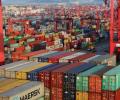
India's exports dipped after a gap of four months in March but finished 2017-18 with a healthy rise of 9.78 per cent to $302.84 billion.

The deficit increased to $ 57.2 billion or 2.1 per cent of gross domestic product (GDP) in 2018-19 as against 1.8 per cent in the previous year.
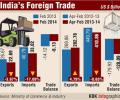
For the April-February period, exports were up 4.79 per cent to $282.7 billion, according to data released by the Ministry of Commerce and Industry on Tuesday.

This hard-fought win also brings relief to Mohun Bagan manager Jose Molina, who had faced 'Go Back' chants at this very venue on Wednesday during their draw in the AFC Cup.

Exports dipped for the 14th month in a row.

Gold imports, which have a bearing on the current account deficit, declined 47.42 per cent to $9.28 billion during April-October due to fall in demand in the wake of the COVID-19 pandemic, according to data from the commerce ministry. Imports of the yellow metal stood at $17.64 billion in the corresponding period of 2019-20. The imports, however, recorded a growth of about 36 per cent in October.

India's gold and silver imports from its free trade agreement (FTA) partner UAE have skyrocketed 210 per cent to $10.7 billion in 2023-24 and there is a need to potentially revise the concessional customs duty rates under the pact to mitigate the arbitrage driving this surge, a report said on Monday. Economic think tank Global Trade Research Initiative (GTRI) said this sharp rise in gold and silver imports is primarily driven by import duty concessions granted by India to the UAE under the India-UAE Comprehensive Economic Partnership Agreement (CEPA).

In sharp contrast, imports grew at a faster rate of 20.6 per cent year-on-year to $39.7 billion in February, translating into a trade deficit of $15.1 billion.

India's exports recorded the slowest pace of growth in three months at 4.3 per cent year-on-year at USD 24.6 billion in February, mainly due to the global slowdown.

Trump threatens to impose additional $200 billion in tariffs on China, Beijing vows to retaliate

India's trade deficit shrank to a 10-month low in December as global oil prices tumbled and demand for gold fell, auguring well for Indian current account balance and the rupee.
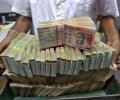
The largest component in computing CAD is trade deficit. India's trade deficit widened to $13.35 billion in October as exports contracted 5.04 per cent and gold imports surged
